


Homebrewing an iconic Westvleteren beer (part 1)
🍺 Why this beer is so special
There is a beer that holds an almost mythical status among enthusiasts. Brewed by a Trappist monastery in Belgium, rarely available and often served in a chalice, this beer is known for its depth, complexity, and the ability to age for years like a fine wine. The best-known variant is the 10.2% ABV quad, praised and coveted. Less discussed but equally intriguing is the dubbel (around 8% ABV). This dubbel often has a rounder alcohol sensation and is considered by many connoisseurs to be easier to drink and complex in a different way than the quad.
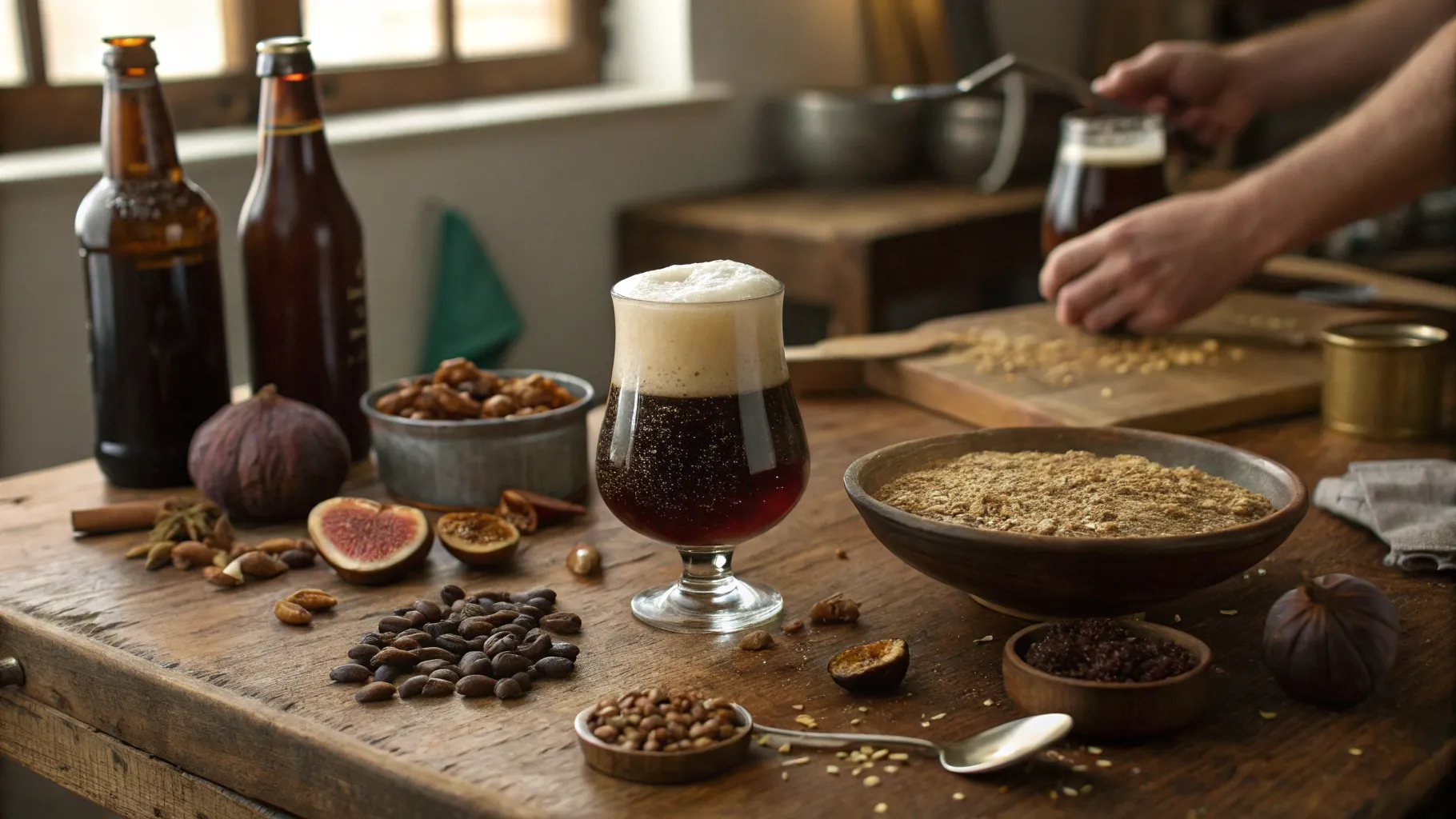
Characteristic aromas and flavors that consistently appear include dried fruit such as figs and raisins, caramel, light licorice, and a subtle roasted or burnt note. Despite the dark color, the mouthfeel is often drier than expected. A remarkable feature is a well-crafted, somewhat assertive hop bitterness and finish that is not always typical for standard Belgian dubbels.
🔎 Research and challenges in cloning
Imitating an iconic Trappist beer is an exercise in detective work. There is rarely an official, complete recipe available; monasteries often protect their processes behind tradition and mystique. Available sources range from old brewing books to modern analyses and unconfirmed homebrew scripts. This makes it necessary to combine historical sources, experienced brewers, and experimental homebrew sessions.
Three typical problems when cloning this type of beer are:
- Inconsistent homebrewer recipes with varying ingredients and techniques.
- Incomplete or vague public information from the brewer themselves.
- The crucial role of yeast and process steps that work differently in small commercial breweries than at homebrewing level.
A clear piece of advice emerging from conversations with experienced authors and brewers is: keep it simple. Complexity in flavor does not have to come from a long list of malts. Often the right yeast and controlled fermentation provide the majority of the characteristic aromas.
Keep it simple. The yeast is not subordinate; the yeast is a partner of the brewer. Give the yeast the conditions it needs and let nature do its work.
🌾 Core ingredients and their role
For a credible approach to the monastery style, the following ingredient pillars are essential.
Base malts
Belgian pilsner or pale malt as a base provides the light, grainy backbone. A second simple malt (for example Belgian Munich or a light caramel malt) can add subtle color and flavor concentration without overloading the bill of materials. The traditional monastic philosophy tends toward two malts rather than a huge mix of specialty malts.
Sugars
Trappist beers often use sugar to keep body lighter and add fermentable sugars. A combination of light (clear) candi sugar and dark candi sugar or invert sugar imitates the character: a light sugar for fermentability and a dark sugar for color and caramel-like tones.
Hop varieties
The hop character seems traditional and noble: soft German hop varieties combined with Central European or Slovenian aroma hops for that assertive yet elegant finish. Think of Hallertau or similar as bittering and a Styrian/Slovenian variety for fine aroma and a lightly spicy note.
Yeast
The yeast is essential. A Westmalle-like or Belgian Abbey yeast produces fruity esters and phenolic spiciness under the right conditions. Instead of trying to force flavors through a tangle of malts, the yeast must be given space: controllable temperature control and the ability to let the yeast work freely.
🧪 A practical clone recipe (batch ±19 liters)
Below is a targeted recipe that stays true to the simple, classic character and is more practical for a homebrewer. The quantities are adjusted for a final volume of about 19 liters and a target ABV around 8%.
Ingredients
- Malts: 4.4 kg Belgian pilsner malt, 0.4 kg Belgian Munich malt (two malt principle)
- Sugars: 400 g light candi sugar (clear), 200 g dark candi sugar or dark invert sugar
- Hops: 12 g Hallertau (4% AA) at 60 minutes, 10 g Hallertau at 15 minutes, 8 g Styrian/Slovenian hop at 5 minutes
- Yeast: Westmalle-like Belgian Abbey yeast (e.g., a commercial culture adaptation), starter 1.2-1.5 L
- Other: water with adjusted minerals (moderate calcium, low sulfate), possibly pH correction to 5.2-5.4
Brewing target values
- OG: around 1.074
- FG: around 1.014
- Estimated ABV: ~7.9% (8%)
- IBU: 22–28 (light noble, noticeable finishing bitterness)
- SRM: 18–25 (ruby to dark)
🍳 Mashing and boiling
The traditional monastic approach can use step mashing. For homebrewers, one low-temperature rest is often sufficient, but when equipment facilitates step mashing, a three-step schedule with a low first rest can guide character and fermentability.
Recommended mash schedule
- 50 degrees Celsius, 15 minutes (protein rest). This helps clarity and foam stability.
- 63 degrees Celsius, 30 minutes (for increased fermentability and drier body).
- 72 degrees Celsius, 20 minutes (maltose rest for balance).
- Mash-out 78 degrees Celsius.
Rationale: a relatively low saccharification creates wort that is highly fermentable. This helps achieve a dry final profile typical of many Belgian abbey beers. At the same time, the protein rest contributes to foam stability.
Boil
- Boil 90 minutes. A longer boil promotes color development and helps calculate the final character.
- Add hops according to schedule. Add the dark sugar in the last 10 minutes for caramel notes. Dissolve the light sugar at the boil or at 0 minutes to maximize fermentability.
- Cool quickly back to the correct temperature.
🌡️ Fermentation and yeast management
The fermentation profile largely determines the final result. A number of crucial points:
- Starter and aeration: a strong starter prevents reductive flavors and ensures healthy yeast activity. Proper aeration or oxygen addition before starting is important.
- Start of fermentation: start moderately, around 18-20 degrees Celsius for controlled ester production and to limit fusel formation.
- Free or open fermentation: open fermentation provides a different microclimate and helps with foam and aroma formation. For homebrewers, a loose lid or a fermentor with ample blow-off often suffices. The mechanics of the 'blow-off' process remove certain lipids that would otherwise affect foam and mouthfeel.
- Late temperature rise: once fermentation is about 80% finished, the temperature can be gradually raised to 26-28 degrees Celsius. This stimulates the yeast to release those characterful esters and soft phenols without excessive fusel production.
- Completion and lagering: after primary fermentation, transfer to a secondary vessel and hold very long cold lagering at 0-3 degrees Celsius. This rests the flavors and increases clarity and maturity.
Allow the temperature to rise when fermentation is about eighty percent complete. This gives the yeast a chance to build extra complexity without producing harmful byproducts.
🍾 Bottling, secondary fermentation and aging
Trappist-style beers benefit from patience. Some guidelines:
- Re-fermentation in the bottle: bottling with a re-fermentation sugar dosage is desirable. With very long cold lagering, yeast or sugar is often readjusted for consistent re-fermentation in the bottle.
- Re-fermentation yeast: when the primary yeast seems depleted after long lagering, it may be necessary to add a small amount of fresh yeast at bottling to ensure reliable bottle re-fermentation.
- Recommended bottle aging: at least 2 to 3 weeks at room temperature for carbonation buildup, followed by several months up to a year or longer at a lower temperature for optimal maturation. The older, the more harmonious the flavors often become.
- Serving temperature: slightly cooler than room temperature, 10-14 degrees Celsius in a tulip or chalice.
🍽️ Flavor profile and food pairing
This beer style is rich and complex yet elegant. Typical flavor notes:
- Dried fruit: figs, raisins, dates.
- Caramel and light toffee by adding dark sugar.
- Subtle licorice or star anise-like notes.
- Yeast esters: banana, pear, light spiciness, and phenols.
- A dry, slightly bitter finish that keeps the beer drinkable despite the alcohol content.
Pairing ideas: aged cheeses, stews with red meat, caramelized desserts, or traditional winter pastries. A less obvious but excellent combination is eating spicy or minty desserts; the acids and spiciness cut through the rich mouthfeel.
🔧 Common problems and solutions
When recreating such a complex beer, various problems can arise. Solutions often focus on process control and yeast management.
Color or flavor deviation
- If the beer becomes too dark: reduce the amount of dark sugar or shorten the boiling time. Note that color and flavor often go hand in hand.
- If the beer is too light: add a small percentage of dark sugar or a lightly caramelized malt in the next batch, but stay within the two-malt principle where possible.
Too many fusel alcohols or burning alcohol sensation
- The cause is often too high fermentation temperatures in the early phase or too rapid temperature increases. Start cool and let the yeast gradually reach higher temperatures as the fermentation process progresses.
- An overly large yeast pitch or insufficient aeration at the start can also lead to unwanted by-products. Ensure a sufficiently large, healthy starter and good aeration.
Lack of typical phenols and esters
- This often indicates too low a fermentation range for the yeast used or too low yeast activity level. Consider a warmer phase later in the fermentation or choose a yeast strain with specifically the desired phenolic properties.
- Open fermentation and allowing a late temperature rise are closely linked to forming those characteristic aromas.
🌍 Ingredient sourcing and ethics
Authenticity does not mean slavishly copying. Respect for the original is important. Trappist beers are connected to monastic communities and traditions. It is appropriate to appreciate those traditions and not claim to be the original. In practice, this means: clearly communicate that it is an interpretation, not a replacement.
There are some handy guidelines for ingredients:
- Use Belgian malts where possible. European malt varieties contribute to the right core aroma.
- Buy candi or invert sugar from reliable sources. The flavor of dark candi can vary greatly between suppliers.
- Choose hop varieties with a noble, herbal signature. Avoid overly aromatic new world hops that introduce fruity notes distracting from the character.
🧭 Practical equipment and process advice
Some equipment choices significantly change the effort or outcome:
- Automatic brewing systems with temperature control make step mashing simple and reproducible. If those are not available, a simple single mash with careful temperature measurement can also yield excellent results.
- A fermentor with a spacious blow-off or a lid that can be loosened is an option. Fully open fermentation carries extra risk of contamination but provides a unique microclimate. For homebrewers, a loose lid or PVC blowoff often suffices.
- Rapid cooling of wort is crucial to avoid oxidation and unwanted byproducts. A plate chiller or immersion chiller is recommended.
🔬 Summary philosophy and final recommendations
Recreating an iconic, fully developed monastery beer is less about stacking dozens of specialty malts and more an exercise in mastering five core principles:
- Simplicity in the malt profile: two well-chosen malts are often sufficient.
- Use sugars purposefully and sparingly for body and color.
- Select yeast with character and use fermentation temperature as a creative tool.
- Respect the process: rest mash, possibly open fermentation, late temperature rise, and long cold lagering.
- Patience: bottle conditioning and longer lagering turn a good beer into a special beer.
A practical rule: when in doubt between extra malts or more attention to yeast and process, the latter choice is preferred. Yeast contributes disproportionately to what makes a Trappist beer so characteristic.
🌟 Next steps for homebrewers
Those who want to try this recipe should start with a small, reproducible batch and take notes. Monitor fermentation closely, measure OG and FG, keep temperature profiles, and record sensory observations during maturation. This way, step by step, a personal interpretation of the classic monastery beer with a unique touch emerges, but with respect for the fundamentals.
An additional tip: share findings in homebrew networks and learn from the experiences of others. In the world of craft brewing, knowledge sharing is often just as valuable as the recipe itself.