



What is British Bitter? Explanation of style, taste, history, and why bitter is so hard to define
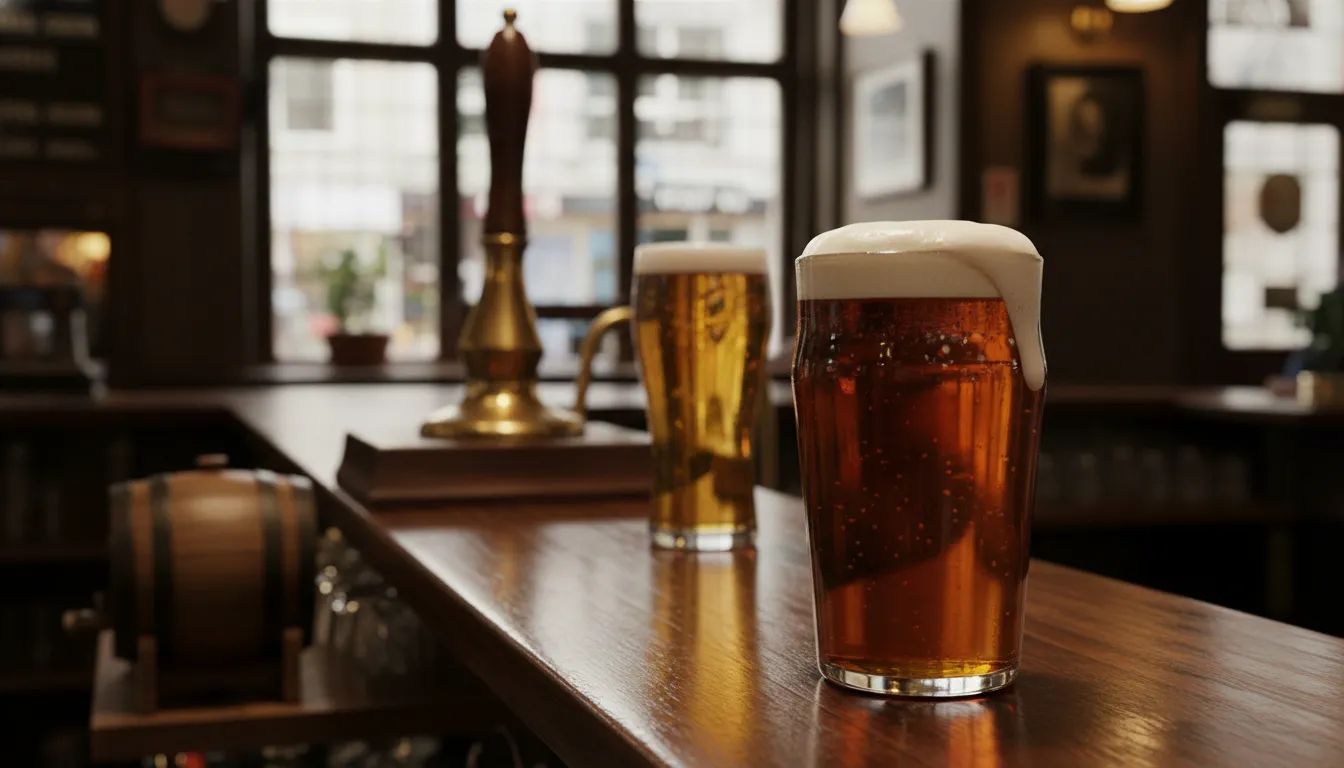
British bitter is a classic British beer style strongly connected to cask ale, pub culture, and a long brewing tradition. Yet bitter is surprisingly hard to define sharply. Some bitters are amber and malty, others are noticeably pale and hoppier. Some taste clearly bitter, others soft, round, and almost marmalade-like.
That’s what makes the style interesting. Those searching for what is bitter beer, what is British bitter, or what is the difference between bitter, pale ale, and mild usually want to know three things:
- What bitter exactly is
- How it tastes
- Why the name and style are so confusing
That’s exactly what this article focuses on. Below you’ll read what bitter historically means, how the style developed, what flavors to expect, why bitter doesn’t always taste truly bitter, and how to recognize a good pint.
🍺 What exactly is British bitter?
British bitter is a traditional British beer style that originated as a name for hoppier, paler ales compared to the sweeter and less hopped beers available in pubs. Originally, “bitter” was not so much a strict style definition as a practical label: this was the more bitter option at the bar.
In modern terms, you can best see bitter as a British session ale with a balance of:
- maltiness
- drinkability
- moderate alcohol
- a clear but not always aggressive hop bitterness
Bitter is often associated with cask ale, meaning beer traditionally served from the barrel in the pub. That’s no coincidence. Bitter is one of the styles most strongly connected to the classic British pint culture.
Important to remember: bitter is a style name, not just a taste description. A bitter doesn’t have to taste as bitter as a modern American IPA.
📚 Why is it actually called “bitter”?
The name has grown historically. In the 19th century, “bitter” was used to distinguish hoppier pale ales from milder, sweeter beers. An important detail is that drinkers often talked about “bitter,” while brewers tended to use terms like “pale ale”.
That immediately explains a large part of the confusion around the style:
- Pale ale and bitter historically overlap strongly
- The term bitter began as the everyday language of drinkers
- Only later was bitter seen as its own beer style
In other words: someone did not necessarily order a strictly defined style type, but simply “the bitter”. This is similar to how people sometimes generally ask for “a blonde beer” or “a dark beer”.
🏛️ The history of bitter in brief
The history of bitter is less straightforward than many think. The idea that bitter has been the standard beer of Great Britain for centuries is not entirely accurate.
Early basis: pale ale versus mild
When pale malt became available and brewers started using higher hop additions, paler, hoppier ales emerged. These held up better and were also associated with maturation and stronger hop use.
At the same time, there was mild, which historically was not initially a style name but rather referred to fresh, soft, and sweeter beer. Mild was for a long time a very important category and remained popular.
19th century: “bitter” as a common term
In the 19th century, bitter increasingly became the informal term for hoppier pale ales. This was not yet a uniform style framework, as various names circulated simultaneously such as:
- pale ale
- India pale ale
- AK
- KK
- other regional and commercial names
The common factor was not a perfectly fixed recipe, but the fact that this was the more hoppy, bitter family of British ales.
For the elite, not for everyone
Another historical point often missing in simple explanations is that bitter and pale ale were not always the people's beer. For a long time, they were relatively expensive and were more associated with the middle class. Cheaper, sweeter styles like mild were more logical for many drinkers.
First World War: style boundaries blur
During the First World War, alcohol percentages dropped due to raw material shortages and rationing. This caused various beer styles to become closer in strength. That made the boundaries between styles less clear. Color, yeast character, and hop use remained important, but alcohol strength became less distinctive.
1950s: the breakthrough of modern bitter
What surprises many beer lovers: the modern, iconic British bitter as many know it is largely a post-war phenomenon. In the 1950s, bitter grew strongly as a style. This was linked to changing tastes, shifting class relations, and a broader cultural shift in British society.
Bitter only became truly massively popular in the second half of the 20th century. Even then, that dominant period was relatively short. The beer later faced competition again from lager.
🧭 Why bitter is so hard to define
Anyone looking for a simple definition of bitter quickly gets stuck, because bitter is at the same time:
- a historical term
- a style family
- a regional tradition
- a pub beer
- not always tasting very bitter
This is not a mistake in the beer world. It is precisely the result of how beer styles develop: not in a laboratory, but in pubs, breweries, regions, and customs.
Two bitters can both be “typically bitter” while differing significantly in:
- color
- hop aroma
- bitterness
- yeast profile
- malt character
If you try to understand bitter as one exact flavor profile, it becomes confusing. If you see bitter as a British beer family centered on balance, sessionability, and pub drinkability, it makes much more sense.
👅 What does a British bitter taste like?
There is no single flavor profile, but most bitters fall within a recognizable spectrum. Often you taste a combination of:
- biscuit-like or bread-like malt
- caramel or toffee
- toasty notes
- earthy, spicy, or grassy hops
- a dry to semi-dry finish
- soft to moderate bitterness
Some bitters also have distinct yeast characters, such as:
- marmalade
- light fruitiness
- a soft bread-like character
- a subtle “twang” typical of a house yeast
What bitter usually is not:
- extremely citrusy like many modern IPAs
- thick and sweet like a strong amber ale
- burnt or roasted like a stout
- clean and neutral like a macro lager
Good bitter is all about balance and drinkability. It is beer meant to remain pleasant pint after pint, without becoming flavorless.
🌾 Which ingredients determine the taste of bitter?
The taste of bitter usually comes from three main components: malt, hops, and yeast. Especially in this style, the interaction between these three is more important than brute intensity.
Malt
The malt base gives bitter its recognizable backbone. Depending on the recipe and region, this results in flavors such as:
- bread crust
- biscuit
- toffee
- light caramel
- toast
The color can range from golden blonde to amber. Therefore, color alone does not say enough about how a bitter will taste.
Hops
Traditional British bitter often uses hops that give earthy, spicy, grassy, or soft floral notes rather than pronounced tropical fruit. The hop character supports drinkability and balance.
It’s important that bitterness in bitter is not just about a theoretical number. How hops are used, stored, and processed also affects the kind of bitterness. That can:
- be soft
- be angular
- feel dry
- give more aroma than harsh bitterness
Yeast
British yeast strains are often crucial. They can give fruity, bready, or marmalade-like notes that distinguish a bitter from more neutral ales. In some classic breweries, the house yeast is even an important part of the beer’s unique character.
⚖️ Is bitter really bitter?
Yes and no. Compared to sweeter traditional British beers, bitter was clearly the bitter choice. Compared to many modern IPAs, bitter can seem quite moderate.
That difference in frame of reference is essential.
For a drinker in the 19th or early 20th century, bitter could be a distinctly hoppy beer. For a contemporary craft beer drinker, the same pint is often more like:
- malty
- soft
- subtly bitter
- classic in profile
That’s why the style name sometimes clashes with taste expectations. People expect something sharper based on the word “bitter” than they get. That tension is one of the reasons why some breweries prefer to speak of amber ale or simply ale.
🆚 What is the difference between bitter, pale ale, and mild?
This is one of the most searched questions about the style. The short answer is: historically the terms overlap, but there are useful differences.
Bitter vs pale ale
Historically, bitter and pale ale are closely intertwined. In many contexts, they largely referred to the same beer family. The difference was often more in terminology than in a completely different style.
Today, “pale ale” can be used more broadly, also for more modern interpretations. “Bitter” more often refers to the traditional British pub style.
Practical distinction:
- Bitter = classic British, cask-oriented, sessionable, malt and balance central
- Pale ale = historically related, but nowadays also used much more broadly and modernly
Bitter vs mild
Mild was historically the softer, sweeter counterpart. Where bitter was associated with more hops and more dryness, mild remained rounder, less hopped, and more accessible.
Practical distinction:
- Bitter = hoppier, drier, often paler
- Mild = sweeter, less hop-driven, often darker in later forms
Bitter vs IPA
IPA and bitter share the same historical lineage, but modern IPA is usually more intense, hoppier, and more aromatic. Bitter is subtler, lower in alcohol, and more focused on pub sessions than on maximum hop impact.
🗺️ Regional differences within British bitter
One of the most interesting things about bitter is that the style can vary by region. So there is no single national template.
In the south, bitters can be more amber and malty, with a clear role for traditional British hops and yeast character. Elsewhere, bitters can appear lighter in color and fresher.
In some northern traditions, bitters are notably blonde and lively, while still being considered bitter. This clearly shows why a strict color definition does not work.
What usually remains consistent despite regional variation?
- the focus on drinkability
- a balance between malt and hops
- relatively modest alcohol
- a strong bond with the pub and cask service
🍻 Why bitter is so strongly connected to cask ale
For many enthusiasts, bitter is almost inseparably linked to cask ale. This is because bitter comes into its own in a traditional British pub setting: fresh, well kept, properly poured, and not ice cold.
That way of serving greatly helps the style. It lets malt, yeast, and soft hops speak better than when the beer is too cold or too aggressively carbonated.
That is why bitter is often seen as:
- a conversation beer
- a session beer
- a beer for longer pub visits
- a style that focuses more on comfort and nuance than spectacle
That does not mean that bitter in bottle or can is necessarily bad, but the reputation of the style has been strongly shaped by cask.
🏷️ Why some breweries avoid the word “bitter”
Although bitter is a historical style name, the word has a problem in modern marketing language. “Bitter” sounds unpleasant or harsh to many people. Moreover, “bitter” is also a negatively charged word outside of beer.
This leads some breweries to choose terms like:
- amber ale
- best ale
- premium ale
- ordinary ale
Understandable, but not without drawbacks. If everyone uses different words, the style becomes even harder for consumers to recognize. That is exactly why many beer drinkers wonder what bitter actually means nowadays.
The irony is clear: the style is historically important, but the name is sometimes seen as commercially difficult.
🔍 Important subtypes: ordinary bitter, best bitter, and strong bitter
Although the transcript source mainly discusses the broad style and does not provide a complete technical classification, it is useful to briefly place the well-known categories. In practice, you often encounter these terms:
- Ordinary bitter or session bitter
- Best bitter
- Strong bitter
The basic idea is simple: they are not completely different styles, but strength levels within the same family. As you go up, you often get a bit more body, malt depth, and intensity. Still, balance and drinkability remain important.
With a best bitter, one usually expects a classic, well-balanced pub ale with a bit more body or character than the lightest variant.
🧪 How to recognize a good bitter?
A good bitter doesn’t need to be loud. Subtlety is often the sign that everything is right. Watch for these points:
1. Balance
No single element should dominate. Malt, hops, and yeast should work together.
2. Drinkability
A bitter can be flavorful but must invite the next sip.
3. Fresh presentation
Because bitter is often relatively subtle, flaws stand out quickly. Oxidation, poor cellar conditions, or tired hops quickly flatten the style.
4. Finish
The finish usually needs to be dry enough to keep the beer lively, without becoming sharp or thin.
5. Character without exaggeration
Good bitter has personality. That can come from yeast, malt, or hops, but remains elegant.
❌ Common misconceptions about bitter
There are surprisingly many misconceptions about bitter. These are the main ones.
“Bitter is always dark amber”
No. Some bitters are amber-colored, but others are much paler.
“Bitter is the same as IPA”
No. They share historical roots, but modern IPA is usually much more expressive in hops and often stronger.
“Bitter tastes very bitter by definition”
No. The style name is historical. In a modern context, bitter can come across as relatively mild.
“Bitter is old-fashioned and boring”
No. Well-brewed bitter actually shows how complex balance can be without extremes.
“Pale ale and bitter are completely different styles”
No. Historically they are closely related and the boundary is often fluid.
🧑🍳 What pairs best with bitter?
Because bitter is about balance and not extreme intensity, it’s a very versatile food beer. It works especially well with simple, savory dishes.
Think of combinations with:
- pork pie
- savory pies
- sausages
- cheddar or other strong cheeses
- pub snacks
- light roasted dishes
The maltiness pairs nicely with roasted or fried flavors, while the hop bitterness helps refresh fat and salt.
🏡 When do you choose a bitter?
Bitter is primarily a beer for moments when you’re not looking for an extreme beer, but something with character. It pairs well with:
- a long afternoon or evening in the pub
- conversations where the beer should be supportive, not dominant
- moments when you want to be able to drink several glasses without flavor fatigue
- for those looking for an alternative to lager but not wanting a heavy ale
That also explains why bitter has such strong cultural significance. It’s not just a style, but also a way of drinking beer.
🛒 What to look for when buying or ordering a bitter?
If you’re consciously looking for a good bitter, these rules of thumb help:
- Don’t just look at the name. Some breweries avoid the word bitter.
- Watch for terms like best bitter, pale ale, or amber ale in a British context.
- Ask about the serving method. Cask can make a big difference to the experience.
- Don’t expect modern IPA aromas. Look for balance, not a hop bombardment.
- Be open to regional differences. A paler bitter can be just as authentic as an amber one.
Those trying bitter for the first time should adjust their expectations. Don’t see it as a British IPA light, but as its own tradition where nuance is more important than intensity.
📈 Why bitter is still relevant
Despite competition from lager and the rise of modern craft styles, bitter remains relevant because it offers something many other styles do less well: flavor without fatigue.
In a beer world where much attention goes to maximum hops, alcohol, or adjuncts, bitter shows that subtlety can also be convincing. The style is also an important part of British beer culture and the identity of many pubs and breweries.
That cultural weight makes bitter more than a nostalgic relic. It is a living style that shows how beer tradition, regional variation, and drinkability come together.
✅ In short: what is bitter beer?
Bitter is a traditional British ale type that historically emerged as the hoppier, more bitter counterpart to milder beers. In practice, it is a broad style family of easy-drinking, malty to hoppy pub beers, usually with moderate alcohol and a strong connection to cask ale.
The main points:
- Bitter is a style name and a historical concept
- The style is often related to pale ale
- Not every bitter tastes very bitter by modern standards
- Regional differences are significant
- Balance, drinkability, and pub culture are central
The best way to understand bitter is not through a strict definition, but through the bigger picture: a British beer tradition where malt, hops, yeast, and context together create a remarkably modest yet deeply characterful beer.