

Unwritten rules in British pubs: how to order, pay, and behave like a local
A pub visit in the United Kingdom often feels cozy and spontaneous, but there are a few unwritten rules that determine whether you have a smooth and pleasant time or cause unnecessary irritation. Whether you order a pint in London or have some food in Scotland (or Wales), these practical tips help you get into the right flow faster.
This guide helps you with the most common situations: ordering at the bar, how the queue works, buying rounds, choosing a pub with real food, considering toilets and steps, and your behavior around closing time and outside.
🍻 Why British pubs have “their own rules”
British pubs are social places, often with fixed habits. Many rules aren’t written on signs but relate to work processes behind the bar, busyness, space, and the daily rhythms of the neighborhood. If you understand that logic, everything runs smoothly: ordering is faster, you don’t disturb anyone, and you enjoy the moment more.
🍺 Rule 1: order (and pay) at the bar
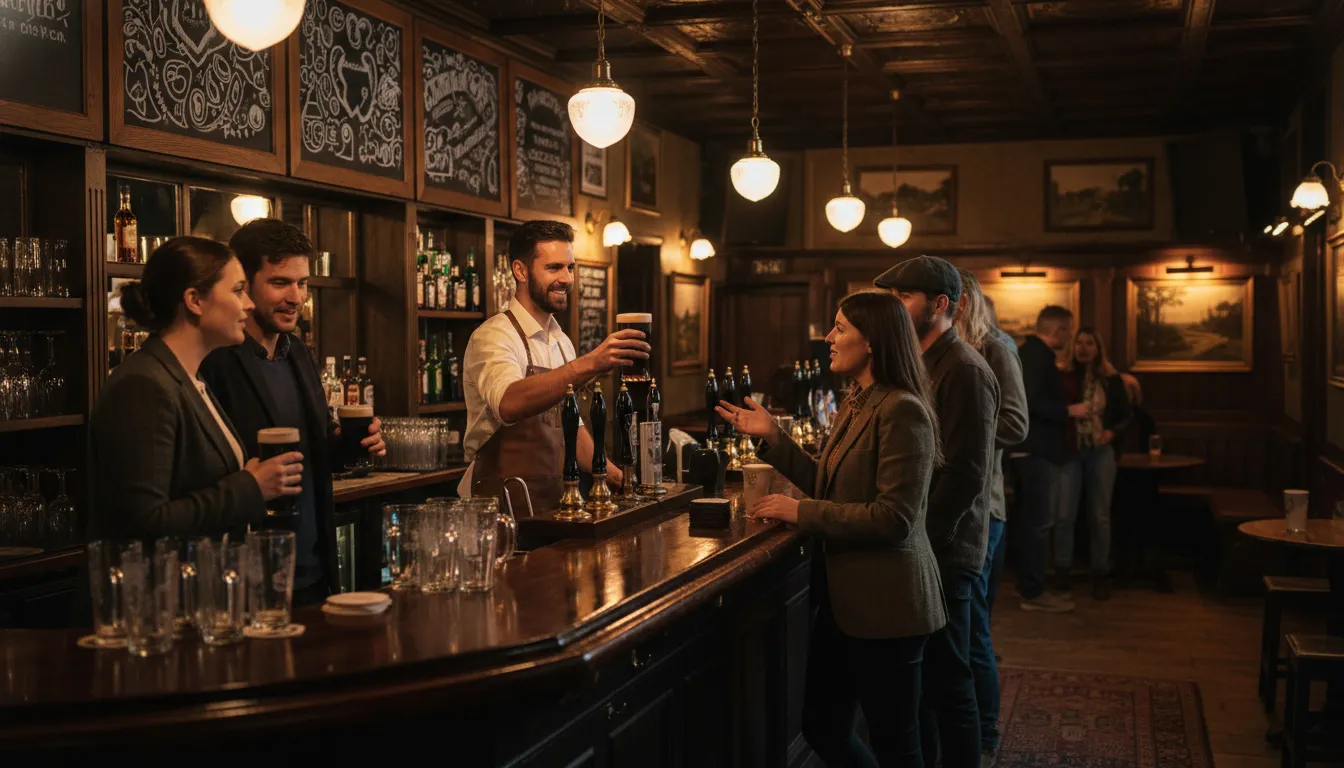
The main basic rule is simple: go to the bar. Your order is not made at the table. So whether it’s drinks, snacks, or food, you arrange it at the bar itself.
There’s one extra point: you pay each time you order. So not “at the end” like some American places. You go up, place your order, pay, and then you get what you ordered.
Practical step-by-step guide for ordering
- Go to the bar and wait your turn.
- Order drinks and/or food.
- Pay immediately when ordering.
- Ask for delivery to your table if you’re not staying at the bar.
When ordering food: table number is often essential
Want food brought to your table? Then it’s customary that you’ve set your table beforehand (or at least know where you’re sitting) and that you give your table number when ordering. The staff will then bring the food to your table. So make sure you have your seat and number in mind before you order.
⏳ Rule 2: respect the queue, even if there’s no “single line”
Waiting is important in the UK. But it can be confusing because you don’t always see one neat long queue. Often people stand scattered around the bar or at different points. In practice, everyone understands who’s next.
That’s why “trying to get through in between” or grabbing attention with quick gestures usually doesn’t work. Just follow the flow: stay where you are, and keep the order right.
What you better not do
- Don’t shout as if the order doesn’t matter.
- Don’t wave to get served faster.
- Don’t push forward if someone was already there earlier.
What you can do
- Keep eye contact with the staff and be patient.
- If someone is served earlier, wait for your turn.
- If you’re accidentally served earlier than expected, a quick “thank you” is enough.
🥂 Rule 3: buy drinks in rounds
In many pubs, the idea of drink rounds is standard, especially with a group. You don’t all go to the bar at the same time to order individually. Instead, you often order “in rounds”: one person goes up, orders for the group, and pays for that round. Then the next person goes.
Each round is paid for by the person whose turn it is. The others get their drinks and that’s it. It’s a kind of rhythm you keep together.
What does that look like in practice?
- Person A orders and pays for the first round for everyone.
- Person B orders and pays for the next round.
- This way it goes around until everyone is satisfied.
“But I’m only staying a moment” or “I only want one drink”
You might only stay for a short time. Then the practical tip is: try to adjust so you get your turn early, so you don’t end up in a situation where you “suddenly” have to join a round while you’re about to leave. Another scenario is that you want to get just one drink: even then it can be expected that you buy a round for the rest when it’s your turn, even if you don’t join that round yourself.
Important to avoid misunderstandings: skipping your round can be seen as a faux pas, especially by regulars.
🍽️ Rule 4: not every pub with traditional food actually serves good food
Many pubs have a menu with traditional dishes. Think of classics like scotch eggs or bangers and mash. However: having a menu doesn’t automatically mean the quality and popularity are the same.
A useful indication is what you see on site. If you feel that food is hardly alive there (for example, because no one is eating even though it’s mealtime), that’s a signal. It doesn’t mean it’s never tasty, but it’s a reason to choose smarter.
Quick decision aid: eating status on site
- Are you going around lunchtime or dinner? Check if people are really eating.
- Are there few or no guests eating during meal times? Consider another pub.
- Do you see several plates with guests? That’s a positive sign.
Use reviews and targeted searching
A practical approach is: look at reviews and ask people on site which pub is suitable for eating. Not every pub is the same kind of destination. Some places are mainly known for drinks, others for food.
If you’re unsure at the moment, a safe option is to go for a pint that evening and arrange food elsewhere.
🧭 Rule 5: consider toilets (often tight, narrow, and via stairs)
Toilets in many British pubs are in basements and often reached by a narrow, steep staircase. That means two things: it can be tricky with large bags, crowds, or if you’re less mobile. In some cases, the toilets aren’t accessible as you might be used to.
If you have mobility issues or want to avoid discomfort, it’s smart to check in advance which pubs suit your situation.
What to watch for before going down
- Is the staircase clearly steep or narrow?
- Are there alternatives or another entrance?
- Is there enough space to walk safely, even when it’s busy?
For those who want to test limits: plan your toilet visit early in the evening so you don’t have to “rush” once the pub gets busier.
⏰ Rule 6: don’t “hang around” after closing time
Many pubs close relatively quickly. That can feel stricter than you might expect. That’s why it’s important not to keep going until staff have finished. When closing time approaches or arrives, it’s time to wrap up and leave.
Staff can remember who stays too long. Not because they’re unfriendly, but because they have work routines and need to close the place properly.
Practical approach at the end of the evening
- Watch the pace: when it gets busier, order only what you really want.
- Finish your last pint faster if you notice closing time is near.
- Don’t ask for “just one more” when it’s clearly closing time.
🌙 Extra attention: be quiet outside the pub
A pub is often in a residential area. That means noise outside matters too: people want to sleep, especially since they work the next day. So make sure you leave with normal, quiet conversation and keep noise under control.
That’s not only polite but also helps keep the pub friendly for everyone.
✅ Quick checklist: how to pub without hassle
Handy to scan quickly before you go inside:
- Order at the bar, not at the table.
- Pay immediately when ordering.
- Give your table number if you want food at the table.
- Follow the queue and don’t try to cut in.
- Buy rounds in a group. Don’t skip your turn.
- Check if people are really eating if you want food.
- Toilet = stairs, often steep and narrow. Check accessibility if in doubt.
- Leave around closing time, don’t “finish up” later.
- Keep quiet outside so neighbors can sleep.
🙋 Frequently Asked Questions about British Pub Etiquette
Do I always have to order at the bar, even if I’m already sitting at a table?
Yes, in most cases ordering is done at the bar. You then ask for delivery to your table by giving a table number.
Is it normal to pay multiple times during the evening?
In many pubs, yes. You pay each time you place an order at the bar.
How exactly do rounds work?
In groups, rounds are often bought. One person orders and pays for everyone, then it’s the next person’s turn. In some situations, it’s expected that you don’t skip your turn, even if you order little or want to leave early.
What if I just want to drink and not eat?
Then your focus is simply on ordering drinks and following the bar’s rhythm: go to the bar, order, and pay. The other rules (queue, rounds, closing time) still apply.
How do I know which pub is good for eating?
There’s no 100 percent method, but you can check signals: do you see guests eating during meal times? And what do reviews and recommendations from others say? If you see little eating activity, that’s a reason to consider another location.
Are pubs always accessible for people with limited mobility?
Not necessarily. Accessibility can vary, and toilets are often reached via narrow, steep stairs. When in doubt, it’s wise to check in advance which pub suits your needs.
🎯 Main mistakes tourists make (and how to avoid them)
Much pub awkwardness comes from a few recurring misunderstandings. With the corrections below, you can avoid most problems:
- Waiting too long at the bar or trying to “jump the queue” → stay in the order others are following.
- Ordering at the table → go to the bar and arrange your order and payment there.
- Not joining rounds → buy your round when it’s your turn (or plan your departure so you don’t “fall out of the round”).
- Choosing a pub based on “they have food” → check if people are actually eating at the time you want to order.
- Going downstairs too late for the toilet → be mindful of narrow stairs and possible crowds.
- Lingering just before or after closing → finish up on time and leave when the pub closes.
📍 Conclusion: pub comfort comes from small habits
British pubs are meant for relaxing, but they operate on their own rhythm. If you order and pay directly at the bar, follow the queue, join rounds, choose food wisely, and keep in mind the toilets, closing time, and neighbors, your visit will likely be much more enjoyable and especially free of awkward moments.
Use the checklist before you order and you’ll find that visiting the pub feels much more “normal” and less like something you have to explain.