



Is Hofbräu the most important brewery in the world?
🍺 Why one brewery had so much influence
The idea that a brewery is more than a place to make and drink beer may sound exaggerated. Yet Hofbräu in Munich ranks historically at the top: not only as an iconic beer hall and brand, but as a political player, national resource, and cultural focal point. In this history, legislation, royal power, wars, folk festivals, and even political extremes intersect. It all begins with a simple but far-reaching choice: who may brew which beer and why.
Hofbräu is important on at least five fronts. First, beer legislation changed agriculture and the economy. Second, the brewery provided income for royal power and geopolitical influence. Third, the place functioned as a social hub and symbol of Bavarian identity. Fourth, beer literally played a role in warfare and city preservation. Fifth, the beer hall was also a space where political ideas were promoted, sometimes with far-reaching consequences.
When you combine these layers, you understand why Hofbräu is more than a brand. It is a case study of how food, culture, and power become intertwined.
📜 Reinheitsgebot: beer conditions and food safety
One of the most influential laws in the history of beer is the Reinheitsgebot, often translated as the German Beer Purity Law. At its core, this law determined which raw materials could be used. The reason was pragmatic and simply food safety: grain was both a raw material for bread and for beer. A poor harvest therefore threatened to raise both bread and beer prices and put pressure on the food supply.
Barley for beer, wheat for bread.
That is essentially the way local authorities wanted to solve the problem. By reserving wheat for bread and barley for beer, the basic food supply was protected. Another goal of the law was consumer protection. In a time without modern food control, brewers sometimes added herbs or other substances that could be dangerous or hallucinogenic. The law limited the recipe to ingredients like water, barley, and hops to counter such practices.
The effect of such a simple rule was enormous. It established technical and cultural foundations for what later became known as the German beer style and quality. At the same time, it also had economic side effects, such as permission for monopolies on certain beer types, and influenced who could produce and who could not.
🏰 How a duke and a brewery created wealth
The political history of Hofbräu begins with the Wittelsbachs, one of Europe's longest-reigning dynasties. They issued laws, levied taxes, and governed areas where beer had been an essential part of daily nutrition for centuries. When the Reinheitsgebot was introduced, the playing field changed: the most popular beers in large parts of southern Germany were wheat beers. A wealthy family bought exclusive rights to continue making that wheat beer. This effectively created a private concession for the region's most popular beer.
The Wittelsbachs saw their income decline and decided to intervene. They founded their own brewery, a royal fortress of production that was to become a direct source of income for the duchy. That brewery is what we now recognize as Hofbräu. Through the combination of political power, smart legislation, and monopoly politics, the dynasty managed to capture the revenues from beer production.
A crucial moment was Maximilian's takeover of power. He professionalized and expanded production, gave his own beer a status stamp, and regulated the market so that his beer became almost mandatory to serve. The result was a stream of income that not only filled the castles but also financed military ambitions and political influence.
Whether dark practices were involved in recruiting brewers and rights remains a subject of speculation and anecdote. The fact is that the political strategy worked. A duchy that partly built its economic base on beer saw its status and territory grow.
⚔️ Beer that saved wars and cities
It becomes painfully clear that beer is more than sociability when you look at war and crisis. With the income from Hofbräu, the Wittelsbachs could finance armies and position themselves more powerfully politically within the web of the Holy Roman Empire. In the chaos of the Thirty Years' War and other conflicts, wealth meant the difference between being occupied and retaining influence.
An almost mythical story about beer and war unfolds with the Swedish invasion. The legendary king of Sweden, known as the father of modern warfare, ventured deep into German territory. Upon his arrival in Munich, he made a remarkable deal: in exchange for huge quantities of beer and gold, he would spare the city. Whether the story happened exactly like this or is somewhat romanticized, it illustrates the value of beer as a means of exchange and a strategic reserve in times of war.
There is also the more practical anecdote in which beer was literally used to fight fires. In winter, when water froze, beer supplies were used to extinguish a fire in an important building. Beer as a firefighting agent sounds absurd, but it points to the enormous storage capacity and logistical importance of large breweries. A well-stocked beer cellar could save lives and buildings in extreme situations.
🍻 From royal taproom to people's hall
Originally, drinking beer at the royal brewery was not a matter for everyone. Royal houses had their own spaces and privileges. That changed in the 19th century when King Ludwig I made the brewery and its hall more accessible to the public. His marriage and the subsequent folk festival are the seed of what would later become Oktoberfest. A royal occasion transformed into a folk festival and brought Hofbräu to the heart of Bavaria as a symbol of gathering.
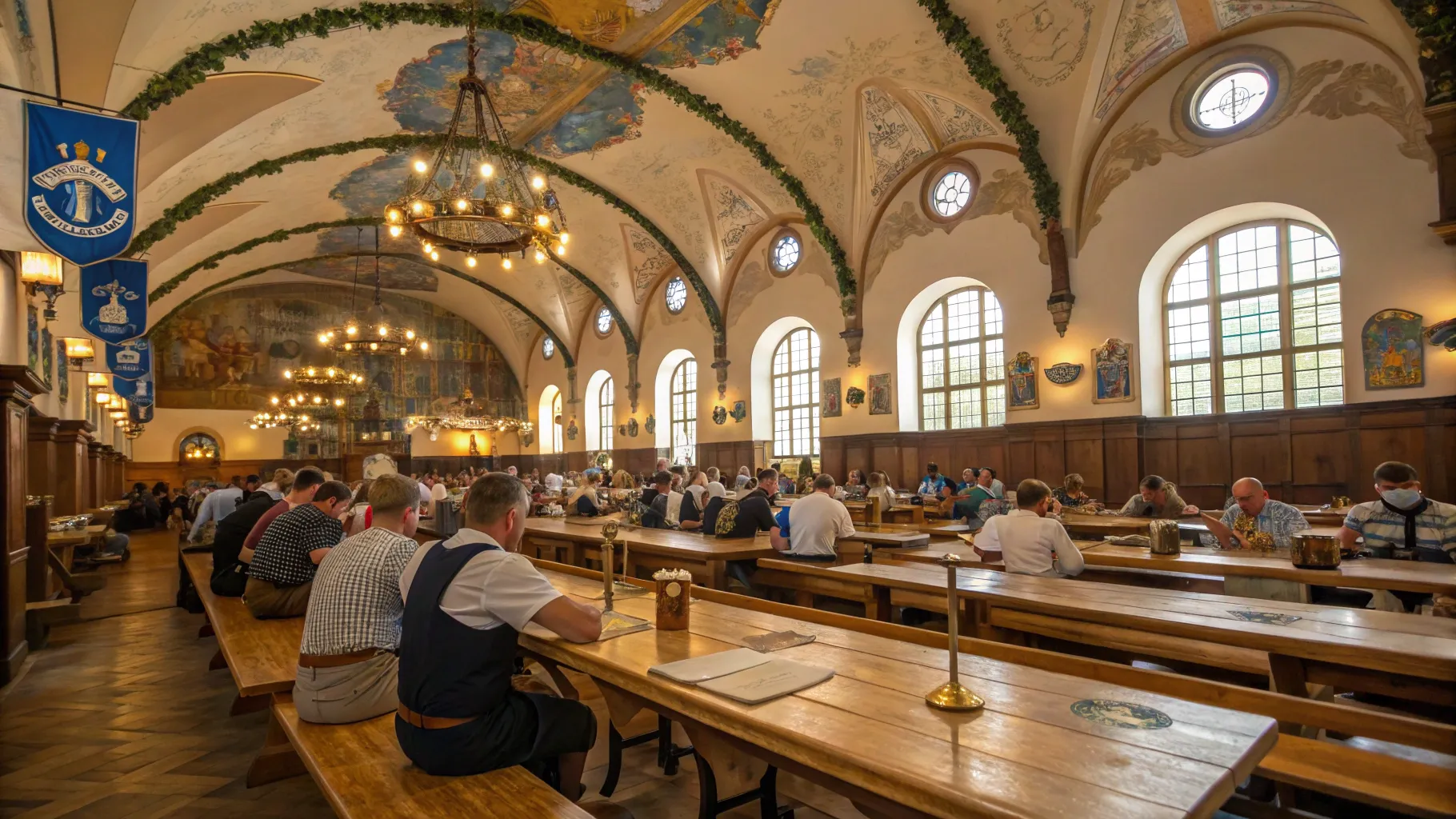
From that moment, the beer hall became a place where everyone could sit at long tables, where both worker and aristocrat could sit next to each other, and where the beer mats and mugs carried shared values. That accessibility is essential: it made Hofbräu a living, social infrastructure, not just a producer of liquid calories.
Along the walls of the large hall, you can still find signs of tradition: hundreds of steins and masks, the personal barrels and markings of regular customers. These objects are telling. They show how communities build their rituals around fixed consumption habits. The beer token is another fascinating piece of culture: its own micro-economy in which tokens have lasting value and nostalgia and investment thinking come together. Some regular visitors praise those tokens as more stable in value than other investments.
⚠️ The dark side: when social spaces are abused
Beer halls are powerful social spaces. They create group bonding, strengthen identity, and lower social inhibitions. This makes them ideal for positive community building and perfect for people who want to gain influence. At this intersection, a dangerous fragility reveals itself. Calculated and charismatic figures can use such spaces to mobilize crowds and spread ideas, and alcohol consumption often lowers critical resistance.
In the first decades of the twentieth century, the beer halls in Munich became exactly that: centers of political debate, radicalization, and recruitment. Various movements, from communists to nationalists, used the hall as a mouthpiece. A young Adolf Hitler began his political career in that same culture of meetings and speeches on café and beer hall stages. He initially worked as an informant and then became involved with a party he slowly controlled by speaking at public gatherings.
The repertoire of political activism included open demonstrations, calls, and attempts at power seizure. A well-known incident is the Beer Hall Putsch, a failed attempt to seize power in Munich. That event led to repression but also to symbolic ritual performance. Later, commemorations of that failed coup were exploited as a pretext for violent antisemitic actions.
It is crucial to interpret this historically: the beer hall itself is not the cause of fascism or extremism. But it was a catalyst during a period of deep social disruption. Poverty, unemployment, and political chaos made large numbers of young men receptive to simple, hostile narratives. The beer hall provided a public stage for that.
🔄 Contemporary legacy: how Hofbräu lives today
Today, Hofbräu is both a museum piece and a living establishment. For travelers, it is often synonymous with tourism: a place where beer, pretzels, and oom-pah music come together in a commercially ritualized experience. For locals, however, it remains a place with history and tradition. Between those two extremes, Hofbräu functions as a cultural icon and economic powerhouse.
Hofbräu produces various styles: the famous Helles, the Weizen interpretations, and the dark Dunkel. The beers have undergone technical improvements over the centuries. Modern lagering techniques, filtering, and purification processes have ensured that what you now see in a glass is often much clearer and more consistent than the beers of the past. But that modern clarity does not detract from the historical value.
Another facet of the modern legacy is the derivative breweries and brands connected to the Wittelsbach family and regional traditions. Some princely domains still brew in castle settings, and events like medieval knight tournaments and reenactments keep old customs alive. That combination of tourist attraction and living tradition makes Hofbräu complex and multifaceted.
🍺 What to taste: Helles, Weizen, and Dunkel
For those approaching Hofbräu with a critical palate, it is useful to know what to expect from the classic styles.
- Helles - A typical Munich Helles is soft, honey- and lemon-like in aroma, with a clean, light grainy mouthfeel. The modern version is often filtered and remarkably clear. Perfect with light meat dishes or a pretzel.
- Weizen - Wheat beers from the region often show banana and clove notes due to specific yeast strains. Historically, they were darker and smokier, but contemporary Weizens are usually blonde and fruity.
- Dunkel - Dark, bready, with notes of caramel, toffee, and lightly roasted grains. This style is often rich and comforting and makes a nice conclusion to a meal.
Many modern tasters appreciate Hofbräu Helles as a benchmark of the style. It is not necessarily the most innovative beer, but it represents a tradition of drinkability, quality, and regional identity.
🧳 Practical tips for a visit
If you ever go to Munich and want to experience Hofbräu, here are a few terrain tips to help get more out of the visit.
- Go on weekdays or early to avoid the worst tourist crowds. Weekend evenings can be hectic.
- Taste calmly and choose different styles. Start with a Helles and work your way to Dunkel or Weizen.
- Pay attention to traditions such as stein markings and tokens. If you're lucky, you'll meet a regular customer with a story behind a particular glass.
- Be prepared for crowds and sometimes loud music. It is a banquet hall, not a quiet café.
- Respect the history and be aware of its ambiguity: zest for life and usefulness on one hand, and moments of political misuse on the other.
🔍 Reflection: a double legacy
Hofbräu is a story of contrasts. It is a symbol of regional pride, folk celebration, and brewing craftsmanship. At the same time, it is also a place where political power was consolidated and where dangerous political currents could take root. That ambiguity tells something fundamental about social spaces and their role in history. Eating and drinking are not just consumption; they are infrastructures of coexistence. When community grows around such infrastructures, it can be both constructive and destructive.
It's tempting to draw simple conclusions. Was Hofbräu the sole cause of the political upheavals in Germany in the twentieth century? Of course not. Was it a link in a chain of factors that paved the way for far-right movements? That it was. And that makes the study of such places important: they show how culture, economy, and power influence each other in far-reaching ways.
🏁 Conclusion: cheers to understanding
There are few places in the world where a pint tells more than just the taste. Hofbräu stands for a history in which beer was straightforward nourishment, an economic engine, a cultural symbol, and a political stage. That complexity is exactly what makes such historical locations fascinating.
Next time you order a clear Helles or walk past a large hall, think about the layers behind it: legislation that changed fields, dukes who collected revenues, soldiers paid with raised funds, and crowds gathered under the notion of community. Beer is simple in the glass, but in its history, it is extremely complex.
Cheers to the lessons contained in a pint.