



Tasting a Westvleteren 8 clone (part 2)
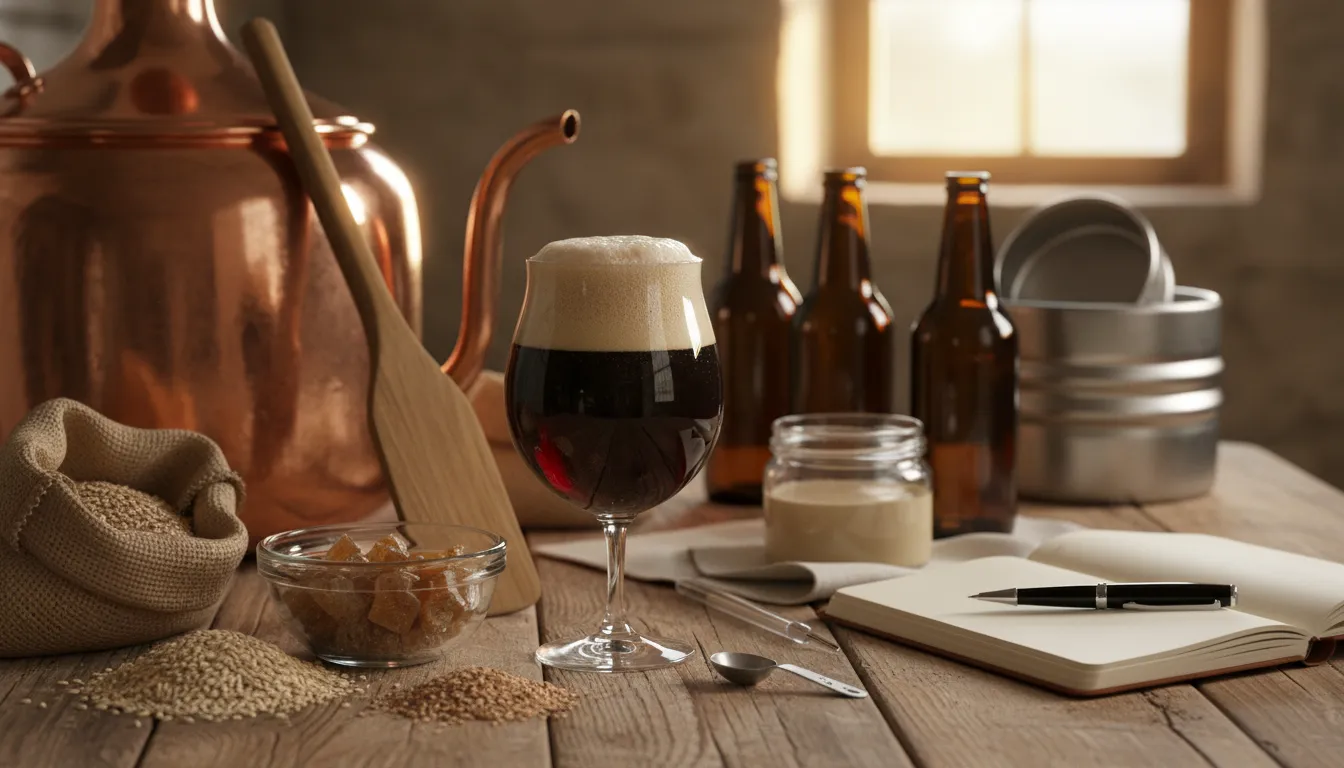
Project overview 🧾
The goal of this brewing recipe was to create the most faithful interpretation possible of the famous Westvleteren 8, the classic Belgian dubbel. The approach combined historical research with practical recipes and experimental process choices: a step mash, a long boil, warm open fermentation, and both bottle and keg conditioning. Although the final result was rated very successful as a standalone beer, it differed visually and in certain flavor notes from the intended original. This text describes the chosen ingredients, yeast and fermentation management, the problems that arose, the bottling and kegging process, tasting notes, and concrete adjustments for future brewing sessions.
The recipe and objectives 🍺
A cloning attempt for a traditional Belgian dubbel calls for simplicity in the malt profile and precision in sugar choices. The philosophy behind this approach was: ingredients that are historically logical for an abbey beer and a process that gives the yeast full room to develop esters and complex aromas.
Key points of the recipe and objectives:
- Use of base malt with limited specialty malts to achieve balance between sweet and dry.
- Addition of Belgian candy sugar to control color, body, and fermentability.
- Step mash with a low first rest for ferulic acids followed by a conversion rest around 65 °C to stimulate high fermentability.
- Warm, open-like fermentation with Westmalle-like yeast for typical banana and spiciness notes.
- Longer lagering and bottle conditioning for softening fusel tones and integrating flavors.
The brewing goal was ultimately not only to approach a flavor example of the dubbel but also to learn which process variables have the most effect on color and aroma.
Step mash and sugars 🔥
The chosen mash strategy was a classic Belgian step mash with attention to an early, low temperature rest and a later conversion rest. Technically, this went as follows:
- Early rest (ferulic acid rest): a short rest at relatively low temperature to promote release of ferulic acids, which can contribute to spicy aromas after fermentation.
- Conversion rest around 65 °C: the main rest for enzymatic conversion of starch to fermentable sugars. This rest supports a fermentable wort and helps create a final dry beer, despite a sweet perception in the mouth.
- Extra time in the mash: increasing contact time is often used to avoid shortening OG; in Belgian beers, OG is not saved.
Regarding sugars, two types of candy sugar were used:
- Belgian dark candy sugar (about 1 kg): responsible for caramel-like notes and a dark copper tint. Dark candy sugar contains melanoidins and residues that contribute to flavor depth and color.
- Light sugar (about 500 g): added for fermentability and alcohol build-up, but can increase color and flavor neutrality.
By adding sugar early in the boil, extra caramelization of the sugar in the kettle occurs, deepening color and flavor. It is important to stir slowly and well when adding to prevent burning on the bottom.
Boiling and hop selection 🌿
After a long, rolling boil of 90 minutes, hop additions were made to deliver subtle bitterness and a herbal/grassy aroma, fitting the abbey profile.
- Magnum (first addition): chosen for a clean, sharp bitterness that can still feel smooth in the final product. Ideal for subsequent aroma build-up without many impurities.
- Hallertauer Mittelfrüh-like aroma (ten minutes): floral, spicy and lightly gingery; pleasant in combination with Belgian yeasts.
- Slovenian Fuggles (Slavinsky): a fuggles-like profile with peachy and soft fruity notes, added for complexity and positively influencing mouthfeel through humulinic lines.
The goal was moderate bitterness that does not overpower the sweetness but balances the body. An OG around 1.074 after sugar addition was targeted, with an FG target around 1.010, resulting in a solid alcohol percentage and enough residual sweetness to make the beer feel "rich" but still dry in mouthfeel.
Yeast, warm open fermentation and yeast behavior 🧪
Yeast choice and fermentation management are crucial for Belgian dubbel character. The focus was on a Westmalle-like yeast profile that generates esters (banana-like isoamyl acetate) and subtle spiciness without producing too much phenolic spiciness.
Important aspects of fermentation:
- Warm initial fermentation with plenty of headspace: to promote esters, the fermenter was not hermetically sealed; gas escape and an open-like environment allowed space for krausen generation.
- Temperature ramp to max around 28 °C during peak: this supports ester production without forcing unfavorable higher alcohols, provided it is well timed.
- Diacetyl rest and extended fermentation: after the active krausen subsided, the temperature was raised briefly to reduce diacetyl and promote complete fermentation.
- Observation of krausen and yeast activity: physical signs of fermentation (swelling krausen, spraying foam layers) gave indications of when temperature steps were needed.
The open fermentation character produced strong ester development. Perfumed aromas of banana and caramel were prominent during active fermentation, indicating a successful execution of the yeast profile.
Problems during fermentation: overflow and cleanup ⚠️
A known risk with open or not fully sealed fermentation is overflow during peak. When yeast is very active and produces a lot of CO2, wort can be pushed up and flow out of the vessel.
What happened and precautions:
- During peak fermentation, significant foam formation and wort expulsion occurred. This led to spillage around the fermenter and extra cleaning work.
- Open fermentation increases ester formation but requires sufficient opportunity for foam and wort to escape. A yeast cap with a slime path or extra headspace helps, as does a collection system for expelled wort.
- Cleaning the brewhouse after such events is time-consuming but necessary; beer aroma and a clean environment are essential to prevent unwanted infections.
Overflow did not necessarily affect the quality of the beer. However, the incident highlights the importance of planning: sufficient headspace, clean drainage options, and the use of fermentation vessels that can handle overflow without contaminating the environment.
Lagering, bottling, and kegging 🍾
After presumed complete fermentation, the beer was cooled and lagered for maturation. The bottling strategy consisted of both bottle conditioning and keg-conditioning, tailored for use during a Christmas celebration.
Main steps and considerations:
- Lagering: about four weeks of lagering at low temperatures to reduce sulfur and resinous tones and to allow flavors to integrate. Although abbey breweries often use longer maturation times, this already provides much smoothing.
- Bottle and keg distribution: some bottles (500 ml) were used for long bottle maturation, with a small yeast pellet added for secondary fermentation. The rest was keg-conditioned for ease of serving.
- Bottle conditioning: a small yeast reactivation was needed because lagering caused much yeast to settle out of suspension. Therefore, a small amount of active yeast (2 g for the small batch) and a calculated amount of sugar were used to reach about 3 volumes of CO2. For 500 ml bottles and the volumes used, this amounted to about 25 g of sugar for the specified total beer quantity.
- Keg-conditioning: the remaining approximately 17-18 liters were kegged with appropriate sugar dosing or controlled gas injection for carbonation.
Bottling requires careful consideration between desired carbonation level, final taste, and safety. Inaccurate dosing can lead to undercarbonation or, worse, explosive discharges in bottles. Therefore, safe amounts and good bottle conditions are essential.
Tasting notes: aroma, flavor, color, and carbonation 👅
After conditioning and a short bottle maturation, tasting sessions took place. The results indicated a beer that was successful in many respects but also showed some consistent deviations compared to the Westvleteren 8 reference.
Aroma
- Pronounced banana-like esters (isoamyl acetate) characteristic of Westmalle-like yeasts.
- Caramel and toffee tones, sometimes described as caramel-baked banana or banoffee dessert, with hints of dried fruit and almond.
- No overwhelming phenols or spiciness; the yeast characteristics leaned more towards fruity than spicy.
Taste
- Sweet to medium-sweet profile in perception, but with a relatively dry finish due to high fermentability.
- Caramel and light raisin-like notes contributed to complexity; the bitterness was slightly lower than expected, giving the beer a softer body.
- Alcohol warmth present but integrated; no sharp fusel tones due to controlled lagering.
Color and appearance
- The beer appeared lighter than a typical Westvleteren 8. Dark candy sugar gave some copper color but insufficient depth to achieve the characteristic dark chestnut brown look.
- The foam head and carbonation were present; for some bottles, a higher carbonation pressure was noted than expected (gushing in one report), indicating variation in priming or temperature control during conditioning.
In summary: the final product was gastronomically high-quality and very tasty on its own—rich, banana- and caramel-driven—but lacked some visual and flavor components specifically associated with Westvleteren 8. There were indications that adjustments in the malt and sugar profile would be sufficient to get closer to the goal.
Recipe adjustments and next steps 🔧
Analysis of the differences led to concrete adjustments in the recipe and process. These adjustments are intended to bring color, bitterness, and certain flavor notes closer to the original, without losing the positive qualities of the current beer.
Proposed recipe and process changes:
- Malt ratio: increasing the share of pale ale malt to about 50% combined with 50% Pilsner. This simple basic reflection aligns with historical monastic methods and can improve balance in body and color.
- Sugar profile: removing light-colored sugars from the boil and using only dark candy sugar for color and flavor contribution. Dark candy sugar contains more aromatic components that enhance color and caramel- and molasses-like tones.
- Bitterness: a slight increase in IBU to better control the perception of sweetness and make the beer seem crisper.
- Boil time and timing of sugar addition: add sugar early in the boil to encourage extra caramelization and color development, but stirring well is essential to prevent burning.
- Fermentation timing and temperature: maintaining the warm, open fermentation and controlled ramp to 28 °C during peak, followed by a diacetyl rest and cooling to lagering.
- Bottle conditioning: accurate priming calculations and stable storage temperature (relatively warm for secondary fermentation, but constant) to avoid gushing and ensure consistent carbonation.
With these adjustments, the expectation is that a next iteration will come significantly closer to the intended profile of a Westvleteren-like dubbel, while retaining the positive characteristics of the current brew.
Lessons for homebrewers and tips for successful clone brewing sessions 📋
Brewing a clone, especially of iconic beers, is less an exact copy and more an exercise in interpretation. The following practical tips help avoid mistakes and speed up the learning process.
- Start with a simple base: keep the malt profile clean and simple. A 50/50 ratio between two base malts (such as pale ale and pilsner) can yield surprisingly authentic results.
- Use candy sugar selectively: dark candy sugar adds color and flavor complexity; light sugar mainly provides alcohol and dryness. The choice and timing of addition significantly influence color and flavor.
- Adjust the mash for fermentability: a conversion rest around 65 °C helps achieve a dry final product without blandness.
- Be careful with open fermentation: it promotes esters but requires sufficient headspace and overflow collection options. Use fermentation vessels with extra space or catch systems if the yeast becomes very active.
- Temperature control is crucial: a moderately elevated temperature during the peak produces esters, but too high temperatures can produce unwanted higher alcohols. Work with controlled ramps.
- Bottle conditioning requires precision: calculate priming sugar accurately based on desired CO2 volumes and consider a small amount of yeast for long-term lagering if yeast sedimentation is significant.
- Document and adjust systematically: in clone projects, small changes in malt, sugar, and hops are often sufficient. A systematic approach with one adjustment per batch makes learning more effective.
Final thoughts and invitation for experiments 🎄
Brewing a clone is a fascinating mix of science, history, and creativity. Even when the final brew does not exactly match the tasted original, it can lead to new, particularly tasty beers that deserve their own place. The experience with this batch provided a series of practical insights: the crucial influence of candy sugar on color and flavor, the power of warm open fermentation for ester profiles, and the necessity of planning with high yeast activity.
For the next iteration, concrete recipe adjustments have been made with the goal of getting closer to the Westvleteren-like dubbel without losing the character of the current beer. The result is an educational cycle that can gradually improve the quality of homebrews. Enthusiastic brewers are encouraged to experiment with malt ratios, sugar profiles, and fermentation techniques, and to carefully document each experiment.
Culinarily, this type of beer pairs excellently with rich winter dishes, desserts like banoffee or caramel cream, and cheese platters with nuts and dried fruit. The brew naturally feels like a festive or Christmas beer: full, complex, and comforting.
Experiment, note, evaluate, and try again. Each round brings new insights and a step closer to the desired aroma profile. Good luck with brewing and tasting.